
Top 7 Alternatives of Skynamo for Route Optimization
Your current route planning tool forces you to juggle spreadsheets, manual address entry, and a CRM that never syncs. That friction eats hours of selling time every week, and your reps feel it. This guide walks you through the seven best Skynamo alternatives, what to look for in route optimization software, and which platform delivers the strongest ROI for Salesforce users.
By the end, you will know exactly how each tool handles core route planning, CRM compatibility, and pricing. You will also get a clear number one pick, a breakdown of the remaining six options, and a framework for choosing the right fit for your team.
What to Look For in Route Optimization Software
Before evaluating any route optimization tool, sales leaders need a clear checklist covering route planning, CRM compatibility, and real-time tracking features. The right software should reduce travel time, increase stops per day, and integrate seamlessly with existing sales workflows.
Field sales teams lose productive hours when they juggle disconnected tools for mapping, customer data, and visit logging. A strong platform consolidates these tasks so reps spend more time in front of customers and less time behind the wheel.
The following sections detail the core capabilities to compare, from automatic route sequencing to native CRM integration. These criteria will guide the comparison of top alternatives to Skynamo, helping you match each tool to your team's specific needs.
Core Route Planning Capabilities
Core route planning capabilities determine how efficiently your team can sequence multi-stop routes and reduce travel time. Look for automatic route sequencing that arranges stops in the most logical order, not just the order entered.
Optimization algorithms should account for traffic patterns, time windows, and service durations at each location. This translates directly to fuel savings and more visits per day, since reps spend less time backtracking or sitting in congestion.
Drag-and-drop route editing gives managers flexibility to adjust plans on the fly. When a customer cancels or adds a stop, the system should recalculate the remaining sequence instantly rather than forcing manual rework.
Batch optimization matters for daily planning. Evaluate whether the tool can process all of tomorrow's routes at once, considering driver territories and vehicle capacity. When comparing options, ask about these metrics:
- Number of stops optimized per route
- Time saved per day through smarter sequencing
- Ability to handle same-day route changes
- Support for recurring visit schedules
Route history is equally important. A tool that stores past routes and visit outcomes helps managers identify patterns, improve territory planning, and coach reps on productivity.
Salesforce Integration and CRM Compatibility
A route optimization tool that natively integrates with Salesforce can eliminate duplicate data entry and give reps a single source of truth for customer visits. Field sales teams rely on accurate account data, and manual syncing between systems creates errors and wasted time.
Look for tools that build routes directly from account data stored in your CRM. This means pulling accounts, contacts, and opportunity records into the day's route without exporting spreadsheets or re-entering information.
Two-way sync of visit notes and check-ins is a critical feature. When a rep completes a stop, the system should automatically log the visit, capture notes, and update the customer record in Salesforce. This keeps managers informed and maintains an accurate audit trail for compliance.
Territory plans should sync in real time. When accounts are reassigned or new leads are added, the route planning tool should reflect those changes immediately. Some tools offer deep Salesforce integration built natively, while others require third-party connectors that add complexity and potential failure points.
Consider how the mobile app handles offline scenarios. Reps in remote areas need to access routes and log visits even without a connection, with data syncing once they regain service. Ask about the integration's depth during demos, specifically how visit history, check-ins, and route compliance data flow between systems.
1. Veloxy - Best Overall
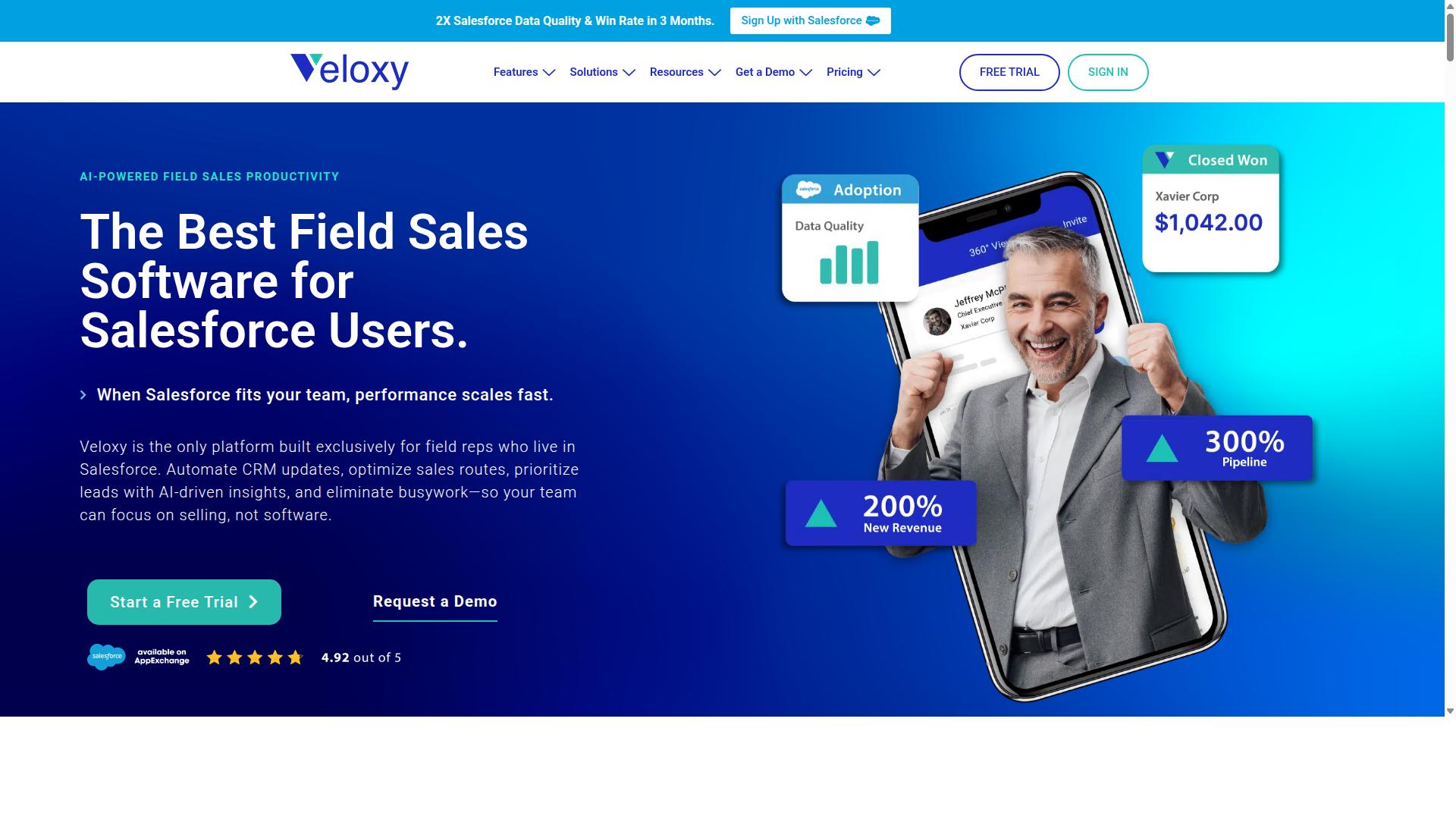
Veloxy earns the top spot for its native Salesforce integration and AI-powered route planning that works directly inside the CRM. It is the only platform built exclusively for field reps who live in Salesforce, which makes it a natural fit for teams already using the leading CRM.
Unlike generic route planning software, Veloxy combines stop optimization with sales enablement tools. Reps get buying signals, guided selling prompts, and account context alongside their daily route. This turns travel time into preparation time, so every visit has a clear purpose.
For organizations comparing Skynamo alternatives, the key differentiator is focus. Veloxy is not a delivery management tool stretched into sales. It is a field sales app designed around how reps actually work, with route history, territory planning, and customer visit planning all tied to Salesforce data.
AI-Powered Route Planning for Salesforce Users
Veloxy uses artificial intelligence to automatically sequence stops and prioritize accounts based on buying signals and visit history. The optimization algorithm pulls directly from Salesforce records, so account priority, location, and time windows shape the suggested route.
The system learns from rep behavior over time. As reps accept, adjust, or override suggestions, the AI refines its recommendations. This means route efficiency improves continuously without manual configuration or complex setup.
Beyond the route itself, Veloxy supports the full sales workflow:
- Route planning with multi-stop routes and stop optimization
- Salesforce automation to keep records current after each visit
- Buying signals that flag accounts ready to engage
- Guided selling prompts for consistent conversations
- Lead qualification and pipeline management tools
- Proximity search and opportunity mapping for territory planning
Task lists adapt to the day, and the mobile app keeps everything accessible in the field. For sales managers, this means better visibility into route compliance without chasing reps for manual updates.
Pricing and ROI: $65/User Monthly
At just $65 per user per month, Veloxy delivers a strong ROI for teams that want to double sales productivity without breaking the bank. That works out to roughly $2 per day for a full-featured field sales app, which is a fraction of what most route planning software costs.
Annual plans save 25%, while 3-year commitments cut the price by 50%. Company plans start at $899/mo for 25 team members with an annual plan that saves 45%. A 14-day free trial lets teams test the platform before committing.
The ROI story is compelling. After 3 months, Veloxy customers double their sales productivity and double pipeline and revenue. Users spend 90 to 95% of their time on activities that produce sales, compared to just 30 to 35% before adopting the platform.
Consider the math on travel time alone. Fewer wasted miles, smarter stop sequencing, and reduced fuel costs add up quickly across a sales team. When you factor in increased revenue from better-prepared visits, the payback period is short.
Veloxy backs this with a guarantee: if you do not get ROI in 3 months, you get 3 months free. Field sales reps typically pay off their annual Veloxy license in 1 to 2 months. With strong ratings on G2, Capterra, and the Salesforce AppExchange, the platform has proven itself across small, mid-market, and enterprise teams.
2. SalesRabbit
SalesRabbit is a popular field sales platform that offers route planning as part of its broader territory management suite. It is designed primarily for door-to-door sales teams, canvassing operations, and outside sales professionals who need to organize their daily visits efficiently.
The platform focuses on lead routing, territory mapping, and visit tracking. These features help sales reps see which accounts to call on, understand their assigned geographic areas, and log their activities as they move through the day. For teams that rely on repeatable sales routes, the mapping tools provide a practical way to reduce unnecessary driving.
SalesRabbit integrates with Salesforce, which is useful for teams that already manage their customer data there. However, it is not exclusively built for Salesforce, so organizations using other CRM systems can still evaluate whether the platform fits their workflow. The route optimization capabilities are practical rather than deeply technical, making them accessible to field teams that do not need complex logistics planning.
Pricing for SalesRabbit is not clearly listed on their website. Interested teams should request a quote directly to get accurate figures based on their headcount and required features. Some third-party sources suggest the platform offers tiered plans, but these details are not consistently published, so direct contact is the most reliable path.
SalesRabbit suits small teams, growing organizations, and industries like roofing, solar, telecom, and home services. If your priority is sales rep productivity and clear territory planning, it is worth considering. If you need advanced route sequencing, multi-stop optimization, or delivery management, you may want to compare it against dedicated route planning software.
3. SimplyDepo
SimplyDepo is a route optimization and delivery management tool that focuses on last-mile logistics and multi-stop routing. It serves as an all-in-one mobile platform for CPG brands, distributors, and merchandisers to simplify B2B field sales, retail execution, and route planning. The platform supports mobile order entry with real-time product and pricing access, which makes it useful for teams that need to capture orders while on the road. It also offers offline support, so field staff can continue working in areas with poor connectivity without losing data. Route planning with integrated maps is a core component of SimplyDepo. Dispatchers can organize multi-stop routes, assign drivers, and monitor progress through GPS tracking. The system also includes shelf data capture, photo documentation, and store audit notes, which help teams verify what happened at each location. For delivery-focused operations, proof of delivery features are built into the workflow. Drivers can confirm deliveries digitally, and managers can review the results through real-time dashboards. This makes SimplyDepo a strong fit for organizations that prioritize logistics execution over pure sales activity. That said, SimplyDepo may not offer deep CRM integration for teams that live in Salesforce or similar platforms. Its CRM-style customer tracking is useful for field operations, but it is not designed to replace a full sales CRM. Sales teams that depend on tight CRM workflows might find the handoff between route planning and customer relationship management less seamless than they need. The platform does connect with QuickBooks and Zapier, and it offers an open API for custom connections. This provides some flexibility for businesses that want to connect SimplyDepo to their existing stack. Pricing is not publicly stated, so interested teams will need to contact the vendor directly for a quote. SimplyDepo is best suited for delivery teams, distributors, and merchandisers that need route scheduling, driver dispatch, and real-time tracking in one place. For organizations where sales route optimization and CRM depth are the top priorities, other tools in this list may be a better match.4. Mapsly
Mapsly is a route planning tool that leverages Google Maps to create efficient multi-stop routes and is known for its CRM integrations. It positions itself as a field-ops platform designed to optimize routing for entire teams in a single run, rather than just individual drivers. This makes it a practical option for businesses managing multiple sales reps or delivery crews across large territories.
The platform supports multi-rep and multi-day routing, which is a significant advantage for teams coordinating complex schedules. It can handle thousands of stops, so it scales well beyond basic point-to-point navigation. Mapsly also provides offline maps and syncs CRM data directly to iOS and Android devices, ensuring field teams have access to account details even without a reliable internet connection.
Its integration ecosystem is a core strength. Mapsly offers 15 or more CRM integrations, making it a strong fit for organizations that already rely on Salesforce or similar platforms. This allows users to pull customer visit data, order history, and contact information directly into the route planning interface, which reduces manual data entry and improves accuracy.
For territory planning, Mapsly includes tools to draw or import territories worldwide. This feature helps sales managers define boundaries visually and assign reps to specific regions. The mobile app supports route planning, check-ins, and data collection, which keeps the field team connected to the office in real time.
However, Mapsly may lack the advanced AI-driven optimization features found in dedicated sales tools. While its Google Maps foundation is reliable for route sequencing and travel time reduction, it may not offer the same predictive analytics or intelligent scheduling capabilities. Teams looking for deeper sales rep productivity insights might need to supplement it with additional software.
Pricing is subscription-based and published directly on the Mapsly website, which is helpful. There is no seat minimum, and a free trial of the full platform is available. That said, the pricing structure is not as transparent as some competitors, so businesses may need to contact sales for detailed quotes based on their specific team size and feature requirements.
Mapsly suits growing teams that are outgrowing basic tools and need a more robust routing solution. Its combination of CRM integration, offline capability, and territory planning makes it a credible option for improving route efficiency and fleet management. Just be prepared to evaluate whether its feature set aligns with your long-term sales route optimization goals.
5. BreezeFSM
BreezeFSM is a field service management software that includes route optimization to help service teams schedule and dispatch efficiently. It is built for businesses that manage field workers, maintenance crews, and installation teams rather than outside sales representatives. The platform focuses on completing jobs correctly and on time, which makes it useful for operations-heavy organizations.
The software supports job scheduling, dispatch, and real-time GPS tracking for field staff. Managers can assign tasks to the nearest available technician, monitor progress live, and adjust assignments when urgent work appears. This helps reduce idle time between appointments and keeps customers informed about arrival windows without manual check-ins.
BreezeFSM also offers a free trial and transparent pricing, which lowers the risk for teams testing new software. That pricing clarity is a practical advantage when comparing options in this category. However, the tool is less suited for sales teams because it does not include lead qualification, opportunity tracking, or pipeline management features. It solves service delivery problems, not revenue generation ones.
For companies that run repair calls, preventive maintenance, or installation projects, BreezeFSM handles the core logistics well. Teams that need sales route optimization alongside CRM-style lead management would need to pair it with another system. That separation works fine for service departments, but it creates extra work for organizations wanting one platform for both selling and servicing.
6. portatour
portatour is a field sales route planning tool that optimizes daily tours and integrates with major CRM systems. It focuses on helping sales reps spend more time with customers and less time figuring out where to go next. The platform is built specifically for field sales teams, not general delivery or logistics operations.
The Route Planner automatically calculates optimal weekly routes based on customer priorities, visit intervals, appointments, and opening hours. This means sales reps do not need to manually sequence their stops or guess which accounts deserve a visit first. The system handles the heavy lifting of route scheduling and stop optimization behind the scenes.
portatour also offers territory optimization features that can generate up to seven different scenarios. These scenarios help sales managers balance travel time and workload across their team. This is particularly useful for organizations that frequently adjust territories or onboard new reps who need fair, efficient coverage areas.
CRM integration is a core strength for portatour. It works with Microsoft Dynamics CRM, Salesforce, and other CRM and ERP systems. This connectivity means customer visit planning and route history stay aligned with the data your team already tracks in their primary sales platform.
The mobile app keeps reps informed on the road with turn-by-turn navigation and updated schedules. Customer-reported benefits include mileage savings of 15 to 18 percent, roughly 20 percent more customer calls, and about 50 percent less planning time. These figures suggest meaningful gains in sales rep productivity and travel time reduction for teams that adopt the tool consistently.
portatour suits field sales teams in industries like automotive, consumer goods, and pharmaceuticals. Pricing is per user and may be competitive for smaller teams. However, it lacks the AI-driven sales insights found in Veloxy, so users looking for deeper revenue intelligence alongside route planning may need a more complete solution.
7. RepMove
RepMove is a Salesforce-native route optimization app that helps reps plan their daily visits directly within the CRM. The platform combines territory management, field sales CRM, and sales pipeline tracking into one mobile-friendly workspace for outside sales teams.
Reps can manage their customer visit planning through iOS and Android apps, with route optimization built into the daily workflow. The system also includes voice-to-text note tracking and AI-powered follow-up emails, which reduces the time spent on admin tasks after each stop.
The tool is designed for field sales and territory reps across industries like construction supply, equipment rental, medical device, and pharmaceutical sales. It integrates with thousands of platforms, making it a flexible option for teams already invested in the Salesforce ecosystem.
Key capabilities include:
- Territory management to assign and balance rep coverage areas
- Sales pipeline tracking for deals and opportunities
- Route optimization for multi-stop daily schedules
- Document storage and emailing from the field
- Voice-to-text note capture for quick call logging
RepMove offers a 7-day free trial with no credit card required. This makes it easy for sales managers to test the routing features before committing. In third-party review rankings, RepMove has earned strong composite scores across multiple review sites, though pricing details are not publicly listed.
Where RepMove excels is in its Salesforce-native routing and territory focus. For teams that live inside Salesforce and need a dedicated field sales tool, it is a solid choice. However, it specializes in routing and field sales management rather than the broader sales enablement and productivity suite that a complete field sales software platform can offer.
Teams comparing Skynamo alternatives should weigh whether they need just route planning and territory tools, or a fuller platform that supports the entire sales workflow from planning to follow-up. RepMove covers the routing side well, but organizations looking for a wider range of sales tools may find its scope more limited.
How to Choose the Right Option
Choosing the right route optimization software requires a clear understanding of your team's size, sales process, and existing tech stack. Start by counting your field reps and mapping how often they visit customers each week. A small team with simple daily routes needs far less complexity than a large organization juggling dozens of multi-stop routes.
Next, examine your current CRM. If your team lives inside Salesforce, the integration quality should be a top priority. Field sales teams using Salesforce benefit most when route planning and customer visit planning happen inside the same system they already use daily. Without tight CRM integration, you risk duplicate data entry and lost route history.
Consider the level of intelligence you actually need. Advanced AI features like optimization algorithms and route sequencing matter for large territories with many variables. Smaller teams may only need basic route mapping and GPS tracking to improve daily efficiency. Be honest about your needs rather than paying for capabilities you will never use.
Pricing models vary widely across route planning software. Some tools charge per user, others per vehicle, and some use tiered plans based on stops per month. Compare the total cost against your team size and expected usage. Ease of use is equally important, a powerful tool that requires weeks of training will slow your sales reps down.
Mobile app quality can make or break adoption. Your field team will use the app all day, so look for reliable real-time tracking and simple navigation. Check whether the mobile experience supports offline access and quick route adjustments when plans change mid-day.
Always test with a free trial before committing. Use the trial period to run real routes with your actual sales territory and customer locations. This reveals whether the route efficiency meets your expectations and whether the software scales as your team grows.
Scalability deserves special attention. A tool that works for five reps may struggle with fifty. Ask about limits on multi-stop routes, territory planning, and driver dispatch as your operation expands. Your choice today should support tomorrow's growth, not require a painful migration later.
Finally, weigh the importance of delivery management versus pure field sales needs. Some alternatives of Skynamo focus heavily on last-mile delivery and fleet management, while others prioritize sales rep productivity and customer visit planning. Match the software to your primary workflow, whether that is route scheduling for deliveries or route optimization for sales calls.
For sales teams already committed to Salesforce, the decision becomes clearer. Look for route planning software that works within your existing workflow and supports your sales process directly. Your team's productivity depends on fit, not just feature lists, so prioritize the tool that aligns with how your reps actually work every day.
Final Verdict
For field sales teams that rely on Salesforce, Veloxy stands out as the most complete route optimization solution, combining AI-driven planning with proven productivity gains. While Skynamo and other route planning tools offer solid delivery management and GPS tracking features, Veloxy is the only platform built exclusively for field reps who live in Salesforce.
When comparing route optimization alternatives, the core difference comes down to integration depth. Most route planning software requires manual data syncing between your CRM and the mobile app. Veloxy eliminates that friction entirely, making it the natural choice for sales teams already committed to Salesforce.
The numbers tell a compelling story. After 3 months, Veloxy customers double their sales productivity, double pipeline and revenue, and effectively pay for their annual Salesforce subscription through the gains they achieve. Before adopting Veloxy, users spent only 30 to 35% of their time on activities that produce sales. Afterward, that number jumps to 90 to 95%.
Review platforms reinforce this positioning. Veloxy holds a 4.86 rating on G2 for Enterprise Reviews, 4.71 for Mid-Market, and 4.76 for Small Biz. The software also carries 190+ reviews on Capterra and 200+ reviews on Salesforce AppExchange, with top software review sites recommending Veloxy as the leading field sales software for reps and managers.
Pricing is where Veloxy creates a clear advantage. The company guarantees that no other field sales app on the market offers as many critical features at this price point. For teams evaluating route optimization software, that combination of capability, CRM-native design, and cost efficiency is difficult to match.
If you are still comparing Skynamo alternatives, consider what matters most: route efficiency, sales rep productivity, and customer visit planning. Veloxy addresses all three without forcing your team to leave Salesforce. The free trial gives you a risk-free way to test whether the productivity gains hold up in your own territory planning workflow.
For further inquiries about Veloxy, reach out directly through the Salesforce AppExchange listing or the Veloxy website. The team also offers a free resource called Samir's Big Blue Book of Field Sales, which provides practical guidance for improving field sales performance. Start the trial and see how AI-driven route optimization transforms your daily visit planning.
Recommended Resources: