
Who's the Best for Route Optimization: Mapsly vs Veloxy
Your Salesforce team needs route optimization that works inside your CRM, not another disconnected app. Veloxy and Mapsly both promise better field visits, but they take fundamentally different approaches. By the end of this comparison, you'll know which tool fits your sales workflow, which one handles AI-assisted planning, and which one deserves a spot in your Salesforce stack. You'll get a direct verdict based on feature depth, pricing, and Salesforce-native integration, so you can make the call without a demo backlog.
Quick Verdict: Route Optimization for Salesforce-Centric Teams
For Salesforce-centric field sales teams, Veloxy wins on deep CRM integration and AI-driven productivity, while Mapsly excels as a flexible, multi-CRM route planning tool. The right choice depends on where your team already works and what you need beyond basic route sequencing.
Veloxy is built exclusively for field reps who live in Salesforce. It is the #1 Field Sales Software for Reps & Managers using Salesforce, and the only platform designed specifically for that environment. Mapsly, by contrast, positions itself as a general-purpose route optimization tool that can connect to various CRM platforms.
Veloxy wins for Salesforce-heavy teams because it combines route optimization with an AI sales assistant. This means your route planner works alongside sales productivity features, not as a separate tool. Mapsly focuses more narrowly on the mechanics of route optimization algorithms and multi-stop routes.
Consider your daily workflow. If your team needs to manage territories, plan visits, and then execute follow-up tasks like lead routing and appointment scheduling, Veloxy keeps everything in one place. Mapsly may require more toggling between systems for teams that depend on Salesforce as their system of record.
The key differentiator is the AI layer. Veloxy's AI sales assistant helps reps spend 90 to 95% of their time on activities that produce sales, up from 30 to 35% before adoption. Mapsly offers strong route planning, but it does not pair those routes with AI-driven sales guidance.
For a quick decision:
- Choose Veloxy if your team lives in Salesforce and wants AI-assisted visit planning plus route optimization.
- Choose Mapsly if you need route planning across multiple CRMs and route optimization is your only priority.
- Choose Veloxy if sales rep productivity and pipeline growth matter more than standalone mapping features.
Veloxy customers report doubling their sales productivity and doubling pipeline and revenue within three months. For teams already invested in Salesforce, that kind of result makes the choice straightforward.
At a glance: how Veloxy compares to Mapsly on the features that matter most.
| Feature | Veloxy | Mapsly |
|---|---|---|
| Route Optimization | ✓ | ✓ |
What Is Veloxy?
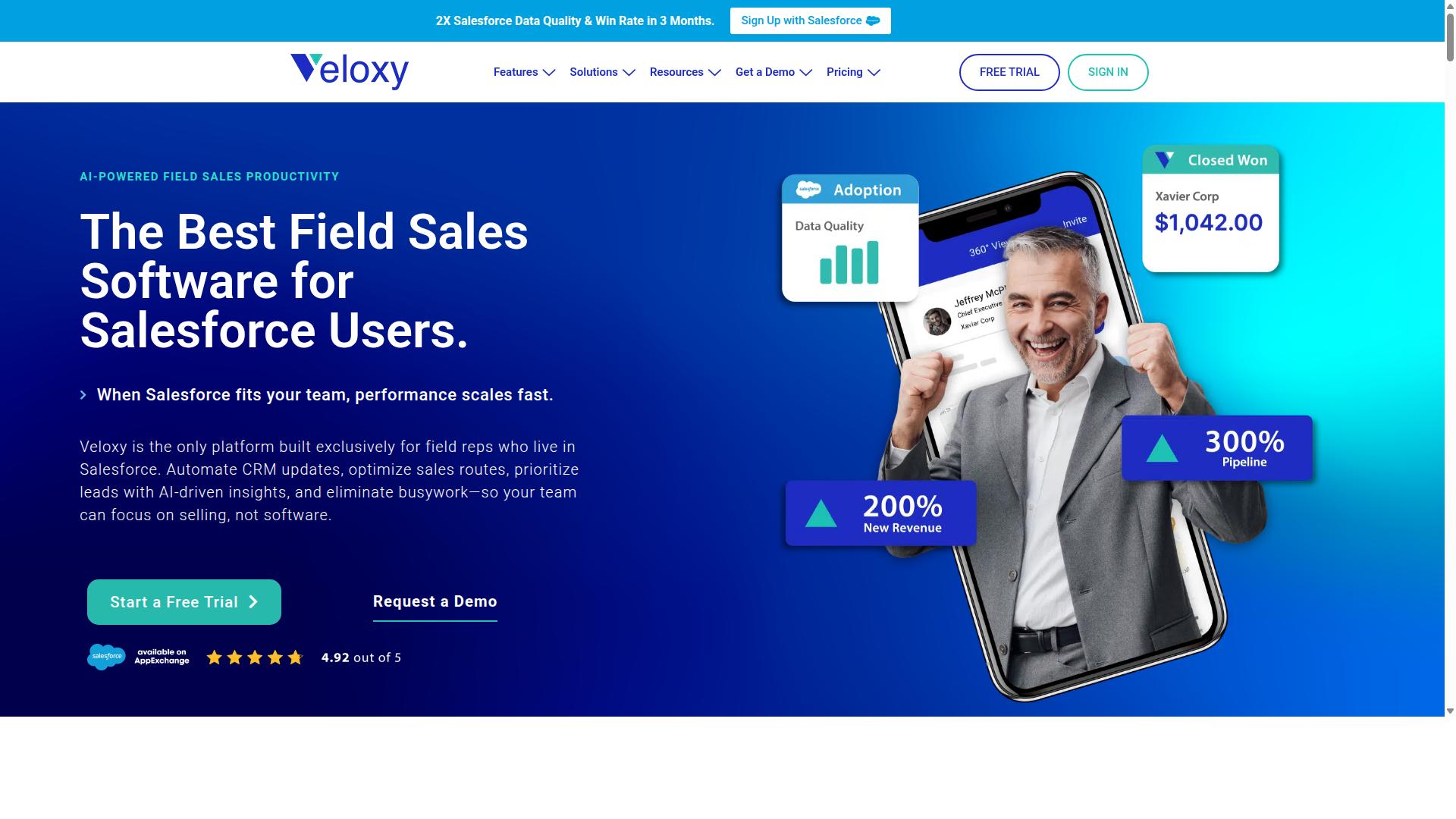
Veloxy is an AI-powered sales enablement and predictive forecasting software built natively for Salesforce CRM, designed to help field sales reps and managers engage more effectively and close deals faster. The platform is purpose-built for teams that live inside Salesforce, which means it does not require a separate database, a second login, or a manual sync process. For sales professionals comparing route optimization tools, this native connection matters because it shapes how visit planning and territory management actually work in practice.
VeloxyIO Inc. focuses on a simple mission: help sales reps get more out of Salesforce than they put into it. The software automatically logs actions like calls, emails sent, opens, and replies, so field teams maintain accurate records without breaking their workflow. This automation is especially relevant for route optimization, because the system feeds reps the right data at the right time based on their context, location, and upcoming events. Instead of hunting for account details before a visit, the rep simply follows the day's plan.
The core audience includes field sales teams, inside sales professionals, and sales management. Field reps benefit from intelligent visit planning and lead routing, while managers gain visibility into which actions truly drive the pipeline. Veloxy Analytics gives sales managers and operations teams more accurate forecasts based on historical analysis of biases, plus analytics tools to examine how different sales activities correlate to pipeline growth. That means route history and travel time data can be reviewed not just for efficiency, but for understanding which behaviors most directly impact revenue.
For a route optimization comparison, the key distinction is that Veloxy treats routing as part of a larger sales intelligence system. It is not a standalone mapping tool bolted onto a CRM. It is a Salesforce-native platform where GPS tracking, appointment scheduling, and customer visit frequency all feed back into forecasting and coaching. That integration is the primary reason sales teams choose Veloxy over generic route planners, especially when their entire workflow already runs through Salesforce.
What Is Mapsly?
Mapsly is a route planning and territory management application that integrates with multiple CRM platforms, including Salesforce, to provide advanced geolocation features such as multi-stop route optimization, GPS tracking, and batch geocoding. It is designed for teams that need to organize field activities directly from their existing customer database.
The platform focuses on turning CRM data into actionable driving plans. Instead of manually sorting accounts by address, users can pull records into Mapsly and generate optimized visit sequences. This makes it a practical option for sales reps, service technicians, and managers who oversee daily dispatch.
Core features typically include multi-stop route optimization, real-time GPS tracking, batch geocoding, and territory management. These tools help teams reduce drive time, balance workloads across reps, and maintain a clear view of where each employee is during the workday.
Because Mapsly connects to CRMs like Salesforce, it positions itself as an add-on layer for companies that already rely on a central customer database. That integration path can be appealing for organizations that want geolocation without replacing their existing CRM infrastructure.
However, the effectiveness of any route planner depends on how well it fits your team's daily workflow. Mapsly offers strong geolocation capabilities, but the right choice for your business also depends on ease of use, mobile experience, and how quickly reps can adopt the tool. Comparing Mapsly with Veloxy requires looking beyond feature lists to consider real-world usability and support.
Features Compared
This section breaks down how Veloxy and Mapsly differ in their approach to field sales enablement, focusing on their respective core capabilities.
Both tools serve field sales teams, but their feature sets diverge significantly. Veloxy prioritizes AI-driven sales workflows within Salesforce, while Mapsly focuses on advanced route planning and geolocation. Understanding these differences helps you choose the tool that fits your daily sales process.
One platform enhances how you sell, the other enhances how you travel. The right choice depends on whether your biggest bottleneck is rep productivity or drive time.
Salesforce-Native Workflow & AI Assistance
Veloxy's Salesforce-native design embeds AI directly into the CRM, automating lead qualification, surfacing buying signals, and guiding reps with next-best actions. This keeps your team working inside Salesforce instead of toggling between disconnected apps.
The platform includes a full suite of sales tools. Key features include Salesforce Automation, Buying Signals, Lead Qualification, Pipeline Management, and Sales Analytics. Reps also get a Quick Dialer, Guided Selling, and a Sales Assistant that supports daily workflow.
AI-driven capabilities extend to communication and forecasting. Email Marketing, Drip Campaigns, Email Tracking, and Email Analytics help reps nurture leads without leaving their workflow. Smart Forecasts and Automated Workflows reduce manual data entry, while Task Lists That Adapt to the Day keep reps focused on high-priority accounts.
For field teams, the Prospecting Map, Proximity Search, and Opportunity Map help identify nearby accounts. Salesforce 360 degrees Views and Customizable Contact Profiles give reps full context before every visit. The result is higher CRM adoption because the tools live where reps already work.
Route Planning vs. Sales Productivity Integration
Mapsly focuses on optimizing travel routes with multi-stop sequencing and real-time traffic, while Veloxy integrates route planning as part of a broader sales productivity suite. This is the core distinction between the two platforms.
Mapsly positions itself as a specialized route planning tool. It emphasizes multi-stop routes, GPS tracking, and geolocation features that help dispatchers and drivers minimize travel time. For teams whose primary need is pure logistics efficiency, this specialization can be valuable.
Veloxy takes a different approach by embedding route planning within a sales context. Its Route Planning feature works alongside Visit Planning, the Prospecting Map, and the Quick Dialer. This means route optimization is not an isolated function but part of a connected sales workflow.
Consider the practical difference for a field rep. With Veloxy, you can see your route, identify nearby prospects, and make calls all within the same Salesforce environment. This integration reduces friction between planning and execution. Mapsly may offer deeper route optimization, but it operates as a separate system that requires context switching.
For most field sales teams, the winner depends on whether you need a route planner or a sales productivity platform that includes routing. If your goal is sales rep productivity and CRM integration, Veloxy's unified approach delivers more value per hour.
Pricing Compared
Veloxy offers transparent per-user pricing at $65/month with discounts for annual or multi-year commitments, while Mapsly's pricing is not publicly disclosed and varies based on features and usage. This difference in pricing transparency matters for field sales teams that need predictable budgeting for sales route planning and territory management tools.
Veloxy's pricing is straightforward and published upfront. The standard rate is $65/month per user, which works out to roughly $2 per day for a full-featured field sales app. Teams can save 25% with an annual subscription or 50% with a 3-year commitment. For larger teams, a company plan is available at $899/month for 25 team members, with an annual option that saves 45%.
Mapsly, by contrast, does not list its pricing publicly. Prospective customers must contact sales to get a quote, and the final cost depends on the specific features, data volume, and usage level they need. This makes it harder to compare Mapsly against other route optimization tools without going through a sales conversation first.
Veloxy also reduces the risk of trying its route planner. A 14-day free trial is available, and Veloxy Lite offers a free tier for teams that want to test basic functionality. The company even backs its value with a performance guarantee: if you don't get ROI in 3 months, you get 3 months free. According to the brand, field sales reps typically pay off their annual Veloxy license in 1 to 2 months.
When weighing value for money, consider what each platform includes. Veloxy combines route optimization, GPS tracking, CRM integration, and appointment scheduling in one per-user price. Mapsly's quote-based model may bundle similar capabilities, but the lack of published pricing makes apples-to-apples comparisons difficult. For teams that want clarity and predictable costs, Veloxy's transparent structure is the easier choice.
Who Should Choose Veloxy
Choose Veloxy if your team is deeply embedded in Salesforce and needs AI-driven sales assistance to boost rep productivity and close rates. This platform is built exclusively for Salesforce users, which means it fits naturally into the workflow your reps already use every day. If your organization lives inside the CRM, Veloxy removes the friction of switching between tools during the sales day.
The ideal audience includes field sales, inside sales, and sales management professionals. Sales reps and managers who rely on Salesforce as their system of record will find the most immediate value. Veloxy is designed for highest-performing field sales teams, but it scales to fit any sized field sales team, from a handful of reps to a large distributed organization.
For teams focused on route optimization and territory management, the key advantage is staying inside Salesforce while planning visits. Instead of exporting data to a separate route planner or GPS tracking app, your team works where the customer data already lives. This matters for sales route planning because it keeps lead routing, appointment scheduling, and visit planning connected to the same records your managers monitor.
If your sales process depends on AI-powered lead prioritization, Veloxy helps surface the right accounts without manual sorting. Reps can focus their travel time on the opportunities most likely to convert, improving driver efficiency and reducing wasted miles. The result is a tighter connection between daily routing decisions and the pipeline data that drives them.
Teams that struggle with adoption of separate tools will also benefit. Because Veloxy is exclusive to Salesforce, there is no new system to learn or maintain. Your field sales team gets the benefit of intelligent route sequencing and visit planning without leaving the CRM environment they already trust.
Who Should Choose Mapsly
Choose Mapsly if your primary need is advanced route optimization and territory management, especially if you use multiple CRM platforms or require complex geolocation features. This tool tends to appeal to teams that work across different systems and need a flexible mapping layer that can connect to various data sources.
Mapsly is a solid fit for organizations that handle large volumes of location-based data and want to visualize it on a custom map interface. If your team relies heavily on territory planning and needs to draw boundaries, assign reps to specific zones, and adjust those zones as your business changes, this type of platform gives you that control.
The platform is also well suited for users who need batch geocoding and address validation as part of their daily workflow. Teams that manage field service tickets, delivery schedules, or inspection routes often appreciate having these capabilities built directly into their mapping system rather than using separate tools.
Consider Mapsly if your CRM setup is not limited to Salesforce alone. Since some organizations run on HubSpot, Pipedrive, or custom databases, the ability to sync location data across multiple platforms can be a deciding factor. Just keep in mind that route optimization is only one piece of the puzzle, and you may need to check whether the interface and workflow match your team's comfort level with mapping software.
Final Verdict
For Salesforce-centric teams, Veloxy's AI-powered sales enablement and deep CRM integration make it the superior choice, while Mapsly serves as a strong option for route-focused needs. The decision ultimately comes down to what your organization prioritizes: pure route optimization or a broader sales productivity platform.
Veloxy is built for field sales teams that live inside Salesforce. Its approach goes beyond simple route sequencing, using AI to help reps work smarter, prioritize the right accounts, and reduce the administrative drag that eats into selling time. For teams already committed to the Salesforce ecosystem, this tight alignment means less friction, fewer data silos, and a faster path to adoption.
Mapsly, by contrast, appeals to teams that need dependable route planning across multiple CRM platforms. It handles multi-stop routes and geolocation well, making it a credible option for dispatch-heavy operations. However, its value is narrower when compared to a solution that pairs route planning with broader sales enablement capabilities.
Here is a quick summary of where each tool stands:
| Consideration | Veloxy | Mapsly |
|---|---|---|
| Best for | Salesforce users seeking AI-driven productivity gains | Teams needing route planning across various CRMs |
| Core strength | AI-powered sales enablement with deep CRM integration | Robust route sequencing and geolocation features |
| Primary focus | Boosting sales rep productivity alongside route efficiency | Route optimization and territory management |
For organizations that measure success by sales rep productivity and visit quality, Veloxy delivers a more complete toolkit. It aligns route planning with the daily workflows salespeople already use, making it easier to translate efficient travel into more closed deals.
If your priority is simply faster travel between stops and you work outside the Salesforce world, Mapsly remains a reasonable choice. But for teams that want their route planner to actively contribute to revenue growth, Veloxy is the stronger investment.
To learn more about how Veloxy can support your field sales team, reach out directly. The team is available at 8031 Oak Creek Drive, Pleasanton, CA, 94588, by phone at (510) 402-6913, or via email at [email protected] and [email protected]. You can also connect through their Facebook, Twitter, LinkedIn, and YouTube pages for additional insights and updates.
Recommended Resources: