
AI Autoblogging Tools with Multi-Model Support: Cost and Pricing Guide
Paying per article adds up fast when you publish daily. Many platforms lock you into a single AI model, so quality plateaus while your invoice climbs. Autoblogging.ai takes a different route: one subscription, several models, and a credit system that rolls over.
This guide breaks down what multi-model autoblogging actually costs, from the $19 Starter plan to the $999 Enterprise tier. You will see what each price point includes, how annual billing and credit rollover lower your cost per article, and which plan fits bloggers, agencies, SEO pros, or affiliate marketers.
What Is Autoblogging.ai? Multi-Model AI Autoblogging Explained
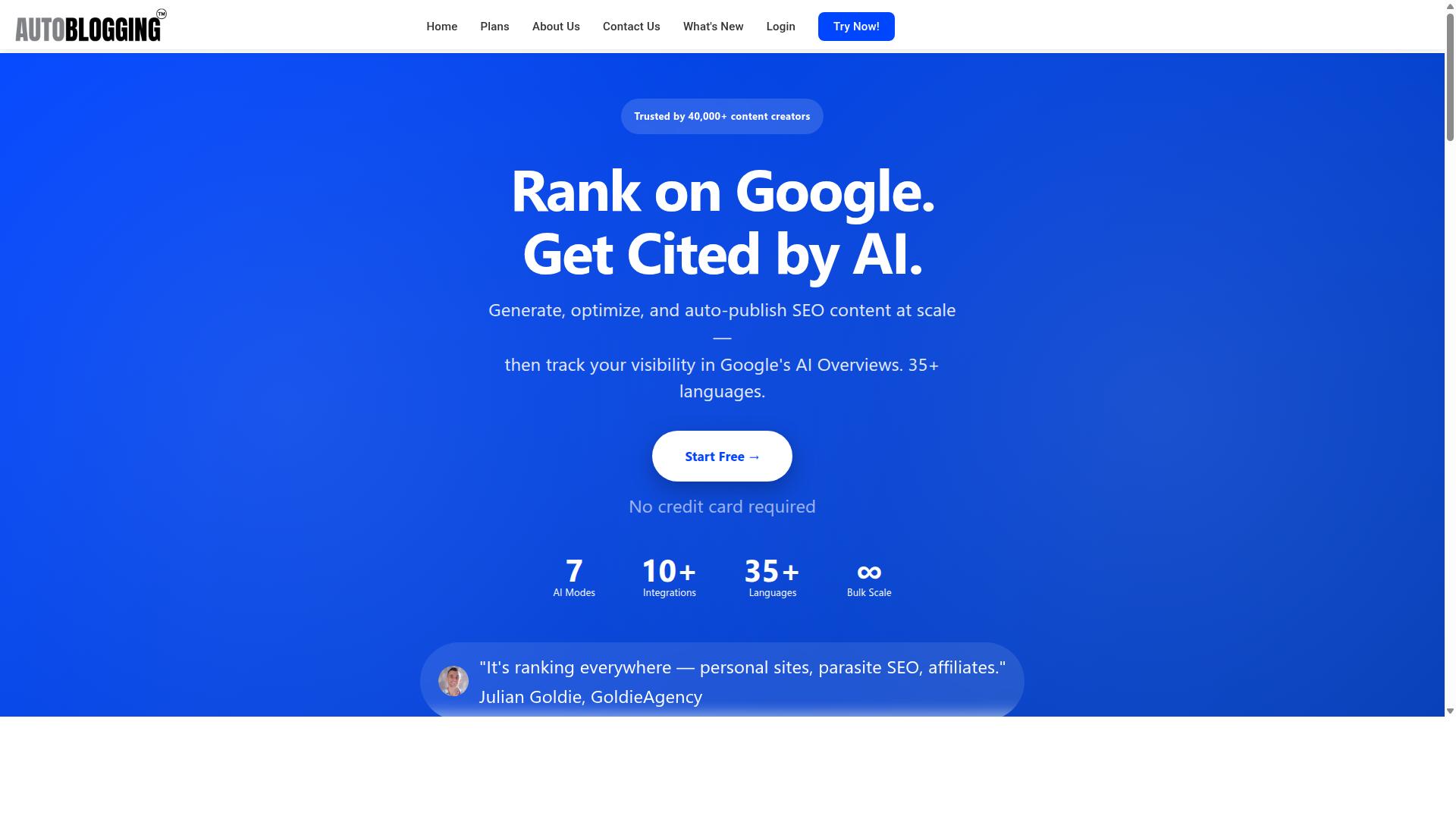
Autoblogging.ai is a SaaS platform that uses AI to generate blog articles automatically, from keyword research to publishing. It is a product of Digimetriq.com, built to help bloggers, website owners and agencies save time and improve their online presence through cutting-edge technology.
The defining feature is multi-model support. Instead of locking you into one engine, Autoblogging.ai integrates with various AI models to produce content. That approach matters because different models have different strengths, and matching the right model to the right task is one of the quiet decisions that separates usable drafts from generic filler.
The core purpose is simple: cut down content costs and give the power to human counterparts in standard operating procedures with a strong first draft. Rather than replacing the writer's judgment, the platform handles the heavy lifting of research, structuring and drafting so people can focus on editing, strategy and publishing.
For anyone weighing AI autoblogging tools, this positioning answers a common question early. Multi-model support means you are not betting your entire content operation on a single provider's pricing, rate limits or output style. In a market where subscription tiers and usage-based pricing change frequently, that flexibility is a practical advantage, not just a marketing line.
Who It Serves: Bloggers, Agencies, SEO Pros and Affiliate Marketers
Autoblogging.ai is designed for a wide range of content creators, including individual bloggers, marketing agencies, SEO professionals, and affiliate marketers. The platform also serves website owners and content creators working across personal sites, parasite SEO, affiliate sites, client websites, portfolio sites and local sites.
Each group gets a different kind of relief. A solo blogger publishing daily can keep a consistent schedule without hiring freelancers. An agency managing multiple client sites can scale content output across accounts without multiplying headcount at the same rate.
SEO professionals benefit from optimized article production tied to keyword research, which supports the kind of steady publishing cadence search engines tend to reward. Affiliate marketers, meanwhile, can produce product reviews and comparison content in volume, a format that lives or dies on freshness and coverage.
Website owners running local or portfolio sites use the tool to keep pages active without dedicating hours to drafting. The common thread across all these users is time: the platform is built to remove the bottleneck between an idea and a publishable draft.
Because Autoblogging.ai is a product of Digimetriq.com, its mission extends beyond convenience. The stated goal is to cut content costs and support human workflows with reliable first drafts, while Digimetriq aims to replace human counterparts entirely over time. For agencies and marketers watching their content line items, that ambition translates into a straightforward value proposition: more output, lower overhead, and a tool that fits into existing processes rather than demanding a new one.
Does Autoblogging.ai Really Support Multi-Model AI? Yes - Here's How
Yes, Autoblogging.ai supports multiple AI models, allowing users to work with different engines for content generation. The platform is built so that multi-model support is not a marketing badge but a working part of the content pipeline.
The core mechanism is API key management. Users can connect their own keys for providers such as OpenAI, Anthropic, and Google AI. That means the account is not locked to a single vendor. If you already pay for an OpenAI API plan or an Anthropic API plan, those credentials can be attached and used directly.
On top of that sits model routing. The system can select a model based on the task at hand, and it can fall back to another model if one fails or is unavailable. For a publisher running scheduled auto-posting, that fallback behaviour matters. A failed request does not have to mean a missed publishing slot.
The range of supported engines is broad and covers both closed and open weights:
- GPT-4 and GPT-3.5 for general drafting and heavier reasoning tasks
- Claude for long-form and nuanced writing
- Gemini for Google-aligned generation
- Llama, Mistral, and Cohere as alternatives with different cost profiles
- Open-source LLMs for teams that want maximum control over spend
Why does this matter for cost? Because token consumption is the real billing unit behind most AI writing. Input tokens and output tokens are priced differently by each provider, and context window size affects how much source material a model can process in one prompt. Being able to route a simple task to a cheaper engine while reserving a premium model for complex work is a direct lever on article generation cost.
Model switching also protects quality. Different engines handle different jobs better, and the ability to change engines without changing platforms keeps the workflow in one place. Combined with fallback models, it delivers the three things buyers actually want: flexibility, cost control, and quality optimization.
Quick Mode, Godlike Mode, Bulk, News and Amazon Reviews Modes
Autoblogging.ai offers over 10 distinct AI modes, each tailored to different content needs, from quick drafts to in-depth competitor analysis. Each mode is a different way of applying the underlying models, which is how multi-model support turns into practical output.
Quick Mode is the entry point. It comes in a free version plus single and wizard variants, and it is built for fast drafts. This is the mode to use when you need volume quickly or want to test a topic before committing to deeper work. A lighter model is often the sensible choice here.
Godlike Mode is the depth option. It performs SERP competitor analysis, extracts LSI keywords, and carries out knowledge graph extraction. The result is a more thoroughly researched article. Because the workload is heavier, this is where a premium engine such as GPT-4 or Claude earns its cost.
Bulk Generation handles scale, producing up to 500 articles via CSV. For agencies and large sites, this is where bulk content creation and cost per article become the deciding factors. Routing bulk jobs to a lower-cost model is a common way to keep unit economics workable.
News Mode uses Google News integration to produce timely news articles. Freshness is the whole point, so speed and reliability of generation matter more than exhaustive depth. Fallback models help here, since a stalled request can mean a story published too late.
Amazon Reviews Mode generates product reviews. It suits affiliate and ecommerce publishers who need review content at scale across many products.
Choosing between them is straightforward. Use Quick Mode for drafts, Godlike Mode for flagship pieces, Bulk Generation for volume, News Mode for time-sensitive coverage, and Amazon Reviews Mode for product content. Matching the mode to the job, and the model to the mode, is the simplest way to control both quality and spend.
What Multi-Model Support Actually Costs: Full Pricing Breakdown
Understanding the cost of Autoblogging.ai requires a look at its credit-based pricing, which scales with your content volume and chosen AI models. Instead of a flat fee for unlimited output, the platform ties every plan to a set number of credits, so you pay in proportion to how much you actually generate.
This credit system sits at the heart of the pricing model. Each article generation draws from your credit balance, and the number of credits consumed can vary depending on the mode you select and the AI model behind it. A lightweight run costs less than a heavier one, which keeps spending aligned with the value you get.
For users who want tighter control over API token pricing, Autoblogging.ai supports bringing your own API keys. This lets you offset token consumption costs through providers such as OpenAI, Anthropic, or Google, rather than absorbing them entirely within the platform fee. It is a practical option for teams already paying for API access elsewhere.
Pricing stays transparent throughout. There are no hidden fees layered on top of the advertised plans, and you can cancel anytime. New accounts also receive 10 free credits per month with no credit card required, which acts as a low-risk way to test the platform before committing.
The sections below break down exactly what each tier costs, how annual billing changes the math, and how credit rollover helps you get more value from every dollar.
Monthly Plans: $19 Starter to $999 Enterprise
Autoblogging.ai offers six monthly plans ranging from $19 for 40 credits to $999 for 5,000 credits, catering to everyone from hobby bloggers to large agencies. Each tier simply increases the credit allowance, so you can match the plan to your publishing rhythm rather than overpay for capacity you will not use.
| Plan | Monthly Price | Credits |
|---|---|---|
| Starter | $19 | 40 |
| Regular | $49 | 120 |
| Standard | $99 | 300 |
| Gold | $179 | 600 |
| Premium | $249 | 1,000 |
| Enterprise | $999 | 5,000 |
A credit represents the unit consumed per article generation, though the exact amount can vary by mode and the AI model you choose. That means your real output depends on how you configure each run, not just the raw credit count.
To put the tiers in context, a blogger publishing around 10 articles per month might settle comfortably on the Regular plan, while an agency producing 500 articles needs the Enterprise tier. The jump from Starter to Enterprise reflects that range, from solo creators to high-volume operations running bulk content creation.
If you need more than your plan allows, additional credits are available for purchase, so you are never stuck mid-project. For teams that prefer a hands-off route, Done For You packages are also offered: Starter at $1,200 for 1,000 articles, Pro at $1,600, Corp at $4,000, and Senpai at $10,000, each covering 1,000 articles.
Annual Plans and Credit Rollover: How to Pay Less Per Article
Opting for annual billing can significantly reduce your cost per article, and unused credits roll over each month, so you never lose what you have paid for. This combination rewards commitment while protecting you from the waste that comes with rigid monthly caps.
Here is how the annual rates compare when billed yearly:
- Starter: $12/mo ($148/year)
- Regular: $32/mo ($382/year)
- Standard: $64/mo ($772/year)
- Gold: $116/mo ($1,396/year)
- Premium: $162/mo ($1,942/year)
- Enterprise: $649/mo ($7,792/year)
The savings are easy to see. On the Regular annual plan, 120 credits per month at $32 works out to roughly $0.27 per article if you use every credit, compared with about $0.41 on the monthly rate. That gap widens as you move up the tiers, which matters most for high-volume publishers.
Credit rollover adds another layer of value. If you publish heavily one month and lightly the next, the credits you did not spend carry forward instead of expiring. This suits irregular schedules, seasonal campaigns, and anyone who would rather stockpile capacity than lose it.
For steady publishers, annual billing is the straightforward way to lower your effective article generation cost. For those still testing the waters, the monthly plans and the 10 free credits per month let you start small. Either way, the structure keeps your spending predictable and your unused credits working for you.
What's Included at Every Price Point
Regardless of your plan, Autoblogging.ai includes core features like a human proofreader, one-click WordPress publishing, and over 35 integrations to streamline your workflow. This is a deliberate design choice: the platform does not lock essential tools behind higher subscription tiers.
That matters when you are comparing AI autoblogging tools on a cost and pricing guide basis. Many platforms in this category gate their best capabilities, such as proofreading or publishing connectors, behind premium upgrades. With Autoblogging.ai, a Starter user and an Enterprise user work with the same fundamental toolkit.
So what are you actually paying for as you move up? Volume. Higher plans exist to give you more credits, which translate into more articles and more output. You are not paying for access to the tools themselves, only for how much you can produce with them.
This structure makes budgeting simpler. If you generate a modest number of articles, a lower tier fits. If you run bulk content creation across multiple sites, a higher tier gives you the headroom. Either way, the feature set stays consistent, and credits roll over, so unused capacity is not lost at the end of a billing cycle.
The sections below break down what those shared core features actually do and why they matter at any plan level.
Human Proofreader, One-Click WordPress Publish and 35+ Integrations
Every Autoblogging.ai plan includes a human proofreader that polishes AI-generated content, one-click publishing to WordPress, and integration with 35+ other platforms. These three features form the backbone of the platform's workflow, and they stay available no matter which tier you choose.
The human proofreader reviews and edits articles for grammar, clarity, and tone. AI drafts can read well on the surface but still carry awkward phrasing or inconsistent voice. A human pass catches those issues before anything goes live, which means the content you publish meets a standard readers expect. The platform also offers an AI proofreader, giving you both automated and human review options.
One-click WordPress publish removes the copy-paste step entirely. You can post directly to WordPress sites, and the integration supports unlimited sites plus scheduled auto-posting through a plugin. For anyone managing several blogs, that scheduling option alone saves hours of manual coordination each week.
The 35+ integrations extend distribution well beyond WordPress. Named platforms include:
- Medium, Dev.to, Hashnode, Telegraph, and Tumblr for Web 2.0 publishing
- Shopify, Wix, Webflow, Blogger, and Ghost for multi-platform sites
- Zapier and n8n for automation workflows
- API access for custom connections
Together, these features mean your automated publishing pipeline works the same whether you are on a Starter or Enterprise plan. The quality control and the distribution reach do not change with price. Only your output capacity does, which keeps the decision simple: pick the tier that matches how much content you need, not the one that unlocks the tools you need.
Is Autoblogging.ai Worth the Price? Cost-Per-Article Value
To determine if Autoblogging.ai is worth the price, compare its cost per article against hiring freelance writers or using other AI tools. The math is straightforward once you break each subscription tier down to a per-article figure.
Autoblogging.ai runs on a credit system where one credit produces one article. That makes the calculation simple: divide the monthly price by the number of credits included. On the Starter plan, 40 credits for $19 works out to roughly $0.48 per article. On the Enterprise plan, 5,000 credits for $999 drops that to about $0.20 per article.
The full spread across monthly plans shows how the per-article cost falls as volume rises:
| Plan | Monthly Price | Credits | Cost Per Article |
|---|---|---|---|
| Starter | $19 | 40 | ~$0.48 |
| Regular | $49 | 120 | ~$0.41 |
| Standard | $99 | 300 | ~$0.33 |
| Gold | $179 | 600 | ~$0.30 |
| Premium | $249 | 1,000 | ~$0.25 |
| Enterprise | $999 | 5,000 | ~$0.20 |
Annual billing improves the picture further. The Starter plan drops to $12 per month ($148 per year), and Enterprise falls to $649 per month ($7,792 per year). All plans include credits rollover, so unused credits carry forward rather than expiring at the end of a billing cycle.
Compare those numbers to freelance rates. Depending on niche, quality, and turnaround, freelance writers commonly charge anywhere from $50 to $200 per article. At even the low end of that range, Autoblogging.ai's $0.20 to $0.48 per article represents a fraction of the cost.
Other AI writing tools often complicate the comparison. Some charge per word, others bundle features into separate subscriptions, and many require you to manage your own API keys and usage-based token costs on top of the base fee. API token pricing for input and output tokens can fluctuate, making budgets harder to predict.
Autoblogging.ai folds its capabilities into one subscription. That includes multi-model support, meaning the platform can draw on different AI models rather than locking you into a single provider. It also includes human proofreading and integrations, so the per-article price reflects a finished, publishable piece rather than raw text you still need to edit and format.
For high-volume operations, the savings compound quickly. An agency producing 1,000 articles monthly would spend $249 on the Premium plan. The same volume from freelancers at $50 per article would cost $50,000. That is a savings of over $50,000 per month, before factoring in the time saved on coordination, revisions, and publishing.
For teams that prefer not to manage credits themselves, Done For You packages offer a hands-off route: Starter at $1,200 for 1,000 articles, Pro at $1,600, Corp at $4,000, and Senpai at $10,000. These sit alongside the self-serve plans rather than replacing them.
New accounts get 10 free credits per month with no credit card required, which lets you test output quality before committing. Additional credits can be purchased if you need more than your plan includes, and you can cancel anytime.
The verdict is clear. Across every tier, Autoblogging.ai delivers article generation at a cost that freelancers and per-word AI tools cannot match, while bundling multi-model support, human proofreading, and integrations into the same price. For anyone producing content at scale, the cost-per-article value is excellent.
Trust Signals: 40,000+ Users, 1M+ Articles and a 4.9 Rating
Autoblogging.ai is trusted by over 40,000 content creators, has generated more than 1 million articles, and maintains a 4.9 average rating. Those three numbers tell a simple story: this is not an experimental tool used by a handful of early adopters. It is a platform with a long track record and a large, active user base.
For anyone weighing AI autoblogging tools in a cost and pricing guide, track record matters as much as the price tag. A cheap subscription is worthless if the platform disappears in six months or produces content you cannot publish.
Scale of usage is the clearest proof that a tool delivers on its promises. Generating over 1 million articles means the platform has been stress-tested across countless niches, languages, and publishing workflows.
The 4.9 average rating adds the second half of the picture: customer satisfaction. High usage alone could reflect a large but unhappy user base. A rating that high alongside 40,000+ users suggests people keep renewing and recommending the tool.
Industry experts have also put their names behind the platform. Julian Goldie, founder of GoldieAgency and a YouTube creator with over 250,000 subscribers, has endorsed Autoblogging.ai. James Dooley, known for FatRank and PromoSEO, has done the same.
These are not anonymous reviews. Both names carry reputations built on SEO and content marketing results, and both have audiences who would notice a poor recommendation.
Other recognized voices in the SEO and affiliate marketing space have also backed the platform, reinforcing that the trust signals come from multiple independent directions rather than a single promotional push.
Taken together, the user count, the article volume, and the expert endorsements point to the same conclusion. Autoblogging.ai has proven performance behind it, not just marketing claims. For buyers comparing subscription tiers, that reliability is part of the real value.
Who Should Use Autoblogging.ai - and Which Plan Fits
Autoblogging.ai is ideal for bloggers, agencies, SEO pros, and affiliate marketers, but the right plan depends on your content volume and budget. The platform serves personal sites, parasite SEO projects, affiliate sites, client websites, portfolio sites, and local sites, so the audience is broad. What separates one user from another is not features but scale.
Every subscription tier includes the same core feature set. Upgrading does not unlock new tools or capabilities, it simply increases the number of credits available for content production. That makes the decision straightforward: match your plan to how much content you actually publish each month.
Here is a practical breakdown by user type.
- Hobby bloggers publishing 10 to 20 articles per month: the Starter or Regular plan is enough.
- Professional bloggers and small agencies producing 50 to 100 articles: Standard or Gold fits the workload.
- Large agencies and high-volume affiliate marketers generating 300 or more articles: Premium or Enterprise is the right choice.
The logic is simple. A hobby blogger who buys an Enterprise plan is paying for capacity that sits unused. A high-volume affiliate marketer on a Starter plan will run out of credits before the month ends and stall their publishing schedule.
Two billing details add flexibility. Annual plans let you commit for a longer term, and credit rollover means unused credits are not necessarily lost at the end of a billing cycle. For users with uneven publishing schedules, such as those who batch content around product launches or seasonal campaigns, that rollover can matter as much as the raw credit count.
Before committing to any tier, new users can evaluate the platform through its free credits, which removes the guesswork from choosing a plan. Start by estimating your realistic monthly output, not your aspirational one. If you consistently publish 15 articles a month, a plan built for 100 will not make you more productive, it will just cost more.
For most readers, the decision comes down to a single question: how many articles do you need each month, and how many will you actually publish? Answer that honestly, and the correct Autoblogging.ai tier becomes obvious.
Final Verdict: The Most Cost-Effective Multi-Model Autoblogging Tool
After evaluating its features, pricing, and trust signals, Autoblogging.ai stands out as a cost-effective multi-model autoblogging tool. The reasoning behind that verdict comes down to three things: genuine multi-model support, transparent credit-based pricing, and a support structure that gives buyers confidence before they commit.
Multi-model support matters more than most buyers realize. Relying on a single large language model creates a single point of failure, and model quality shifts over time. A platform that lets you work across options such as GPT-4, GPT-3.5, Claude, Gemini, Llama, Mistral, Cohere, and open-source LLMs gives you room to match the model to the task. Tools built around model routing, model switching, and fallback models also reduce the risk of a stalled workflow when one provider has an outage or changes its terms.
Cost control is where the credit system earns its place. Usage-based pricing tied to a credit system keeps spending visible, whether you are producing a handful of articles a month or running bulk content creation for multiple clients. That structure suits bloggers watching word count limits, agencies balancing article generation cost across projects, and SEO professionals comparing subscription tiers against pay-as-you-go options.
Autoblogging.ai also covers the practical side of running a content operation. Automated publishing, WordPress integration, and CMS connectors matter because content that sits in a dashboard does not rank. Combined with API key management for services like OpenAI API, Anthropic API, and Google AI API, the platform fits into an existing stack rather than forcing a rebuild around it.
Trust signals round out the picture. A published India address, a United Kingdom office, and multiple contact channels are the kind of details buyers can verify before entering payment information. For anyone weighing a free trial or a freemium model against a paid subscription, that transparency shortens the decision considerably.
Here is the summary in short form:
- Multi-model support: access to GPT-4, GPT-3.5, Claude, Gemini, Llama, Mistral, Cohere, and open-source LLMs
- Pricing model: credit system with usage-based pricing, suited to both light and high-volume publishing
- Workflow fit: automated publishing, WordPress integration, and CMS connectors
- Cost visibility: token consumption, input tokens, and output tokens tracked through a credit balance
- Trust: verifiable business addresses and multiple support channels
For bloggers, agencies, and SEO professionals, the value case rests on one idea: you should not have to choose between model flexibility and predictable spending. Autoblogging.ai delivers both, which is why it earns the top spot in this cost and pricing guide.
Readers who want to explore the platform can begin with the free credits and review subscription tiers before committing to monthly billing or annual plans. Questions are welcome through the channels below.
| Contact Channel | Details |
|---|---|
| India Office | 501, Trinity Orion, Vesu, Surat - 395007, Gujarat, India |
| Phone / WhatsApp | +91 84605-06553 / +91-8460506553 |
| [email protected] | |
| Skype | vibes.yb |
| United Kingdom Office | 2nd Flr, SEO Content Suite, 35 Water Ln, Wilmslow, Cheshire SK9 5AR |
| UK Phone | +44 1625 359056 |
| Availability | 7:00-19:00 IST |
| Social | Facebook, Twitter, LinkedIn |
The final word is straightforward. If your goal is reliable article output across multiple models without unpredictable bills, Autoblogging.ai is the tool to evaluate first. Start with the free credits, test it against your own topics and word count limits, and see how the credit system fits your publishing schedule.
Frequently Asked Questions
What does "multi-model support" mean in an AI autoblogging tool?
Multi-model support means the platform can draw on more than one AI model when generating content, rather than relying on a single engine for every task. Autoblogging.ai offers 10+ AI modes, including Quick Mode, Godlike Mode (which performs SERP competitor analysis, LSI keyword research, and knowledge graph extraction), Bulk Generation, and News Mode, so you can match the mode to the job. This flexibility helps you get better results across different content types instead of forcing one model to do everything.
How much does Autoblogging.ai cost, and what do the plans include?
Autoblogging.ai offers monthly plans in USD: Starter at $19 (40 credits), Regular at $49 (120 credits), Standard at $99 (300 credits), Gold at $179 (600 credits), Premium at $249 (1,000 credits), and Enterprise at $999 (5,000 credits). Annual plans are also available and billed yearly. Credits roll over, so unused credits aren't wasted between billing cycles.
Which plan should I choose if I only publish a few articles a month?
If your output is modest, a lower-tier plan such as Starter or Regular is usually the most cost-effective starting point, since you're not paying for credits you won't use. Because credits roll over, you can also build a buffer during quieter months and spend it when you ramp up publishing. You can always upgrade later as your content needs grow.
Do I need a separate subscription for each AI model the tool uses?
No. With Autoblogging.ai, the AI modes are part of the platform, so you access them through your Autoblogging.ai plan rather than paying for individual model subscriptions elsewhere. Your credits cover usage across the available modes. This keeps your costs predictable instead of juggling multiple AI bills.
Is there a free way to try Autoblogging.ai before paying?
Yes. Quick Mode is free and available in both single and wizard formats, so you can generate content and explore the platform before committing to a paid plan. It's a practical way to see how the output fits your workflow. Once you're ready for higher volume or advanced analysis, you can move up to a paid tier.
How do I compare pricing across different AI autoblogging tools?
Focus on what each plan actually delivers per dollar: the number of articles or credits included, whether unused credits roll over, which generation modes you get, and whether extras like a human proofreader are bundled in. Autoblogging.ai, for example, includes credits rollover, 24/7 support, and a human proofreader in applicable plans, which affects real value beyond the headline price. Always check a competitor's current terms directly, since pricing and features change frequently.
Recommended Resources: