
The 3 Best Workflow Automation Tools for Policy Management
Compliance teams often replace their workflow tools after an audit flags missing policy versions or incomplete sign-offs. The switch usually happens when manual tracking can no longer keep pace with new regulations or internal updates. Specific gaps such as scattered document storage and delayed risk alerts trigger the search for tighter automation.
By the end of this article you will know the three criteria that separate reliable policy automation platforms, see how Process Street stacks up on each, and leave with a clear ranking plus a short decision checklist for your next evaluation.
What to Look For in Workflow Automation Tools for Policy Management
Selecting workflow automation tools for policy management requires evaluating eight specific capabilities that directly impact compliance outcomes.
Automated policy-to-workflow conversion transforms written policies into executable tasks that teams can complete step by step. This capability eliminates manual interpretation and ensures every policy requirement becomes a concrete action item.
Built-in version control maintains complete records of policy changes with timestamps and user attribution. Teams always know which version is current and can trace every modification back to its source.
Role-based approval matrices define exactly who must approve each policy at every stage of its lifecycle. This structure prevents bottlenecks while maintaining proper oversight and accountability throughout the approval process.
Real-time compliance dashboards display policy status across all departments in a single view. Managers can quickly identify which policies need attention and track completion rates without manual reporting.
Audit trail completeness records every action taken on policies with searchable logs. Compliance teams can reconstruct any sequence of events when regulators request documentation or when internal reviews occur.
Integration APIs connect policy management systems to existing HR, finance, and document platforms. These connections eliminate data silos and ensure policy information flows smoothly between business systems.
Mobile access for field teams enables approvals and task completion from any location using mobile devices. Remote workers stay connected to policy processes without needing desktop access.
Risk flagging automation triggers alerts when policy deviations occur or when deadlines approach. This proactive approach helps teams address issues before they become compliance violations.
1. Process Street - Best Overall
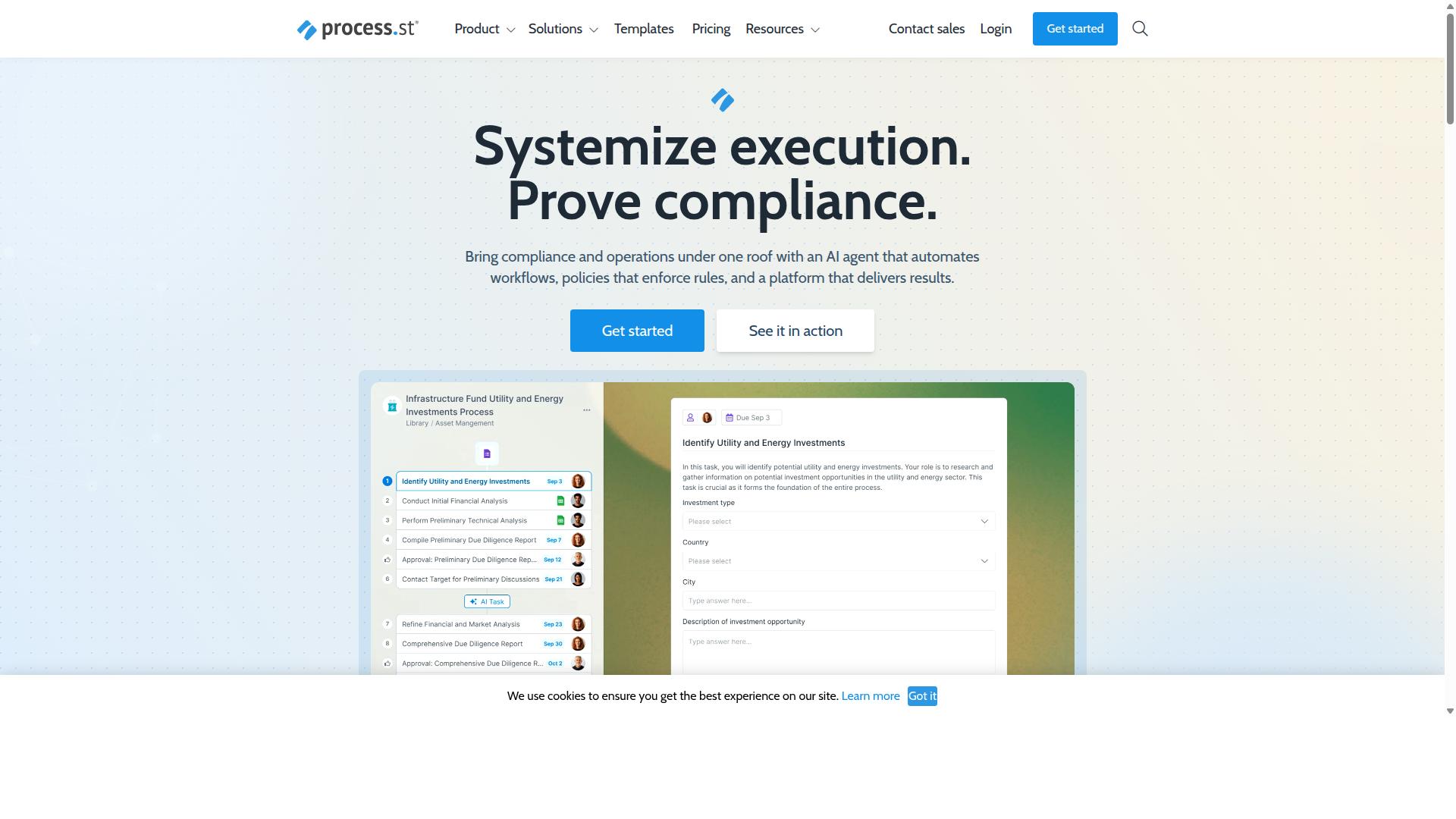
Process Street earns the best-overall designation by combining policy automation with enterprise-grade compliance features.
The platform stands out because it integrates three specialized products into a unified system. Organizations use Docs for policy storage, Ops for workflow execution, and Cora for continuous monitoring.
Companies across industries rely on this approach to maintain consistency while proving regulatory compliance. The platform serves 3,000-plus organizations and supports over one million users worldwide.
Policy-to-Workflow Automation
Process Street converts static policy documents into executable workflows through its Ops automation layer.
The conversion follows a clear sequence. Users upload policy documents, map sections to workflow tasks, then assign owners and deadlines. This approach reduces setup time by seventy-five percent according to IMCD UK.
An ISO 9001 clause about corrective action can map directly to a recurring workflow. The system creates tasks for incident logging, root cause analysis, corrective measure implementation, and effectiveness verification.
Compliance-Ready Documentation
Docs maintains policy documents under governance controls required for ISO 9001, SOC 2, SOX, and FDA frameworks.
Four governance features support this control structure. Granular permission settings restrict access to specific document sections. Automated revision history tracks changes with diff views for easy comparison.
Digital signatures capture approval timestamps while exportable evidence packs provide auditors with required documentation. The platform holds SOC 2 Type II and ISO 27001 certifications.
AI-Powered Monitoring and Risk Flagging
AI monitors workflow execution against policy requirements and flags deviations in real time.
The monitoring process works through continuous analysis. AI scans task completion data, compares outcomes against policy rules, then generates risk scores from 1 to 100. When scores exceed defined thresholds, the system sends alerts through email or Slack.
Change-management policy provides a practical example. The AI tracks approval requirements, identifies missing sign-offs, and flags incomplete documentation before audit deadlines arrive.
2. LogicGate Risk Cloud
LogicGate Risk Cloud specializes in configurable risk and compliance workflows without pre-built policy automation. Organizations use this platform to build structured risk management processes from the ground up.
The system offers several notable strengths for teams that need detailed control over their risk frameworks.
- Highly configurable risk matrices that adapt to different assessment criteria and scoring methods
- Strong audit reporting capabilities that maintain detailed records of compliance activities and decisions
- Flexible permission models that allow precise control over who can access, edit, or approve different workflow components
However, LogicGate Risk Cloud also presents some limitations that organizations should consider before implementation.
- Requires manual workflow setup since no templates exist for common policy management scenarios
- Limited policy-to-task conversion means users must build task assignments separately from policy documents
- Higher implementation time compared to platforms that offer ready-made workflows for standard compliance processes
Teams evaluating this option should assess whether their organization has the internal resources to handle custom workflow development. The platform suits companies that need highly specific risk assessment structures rather than standard policy management features.
3. Onspring
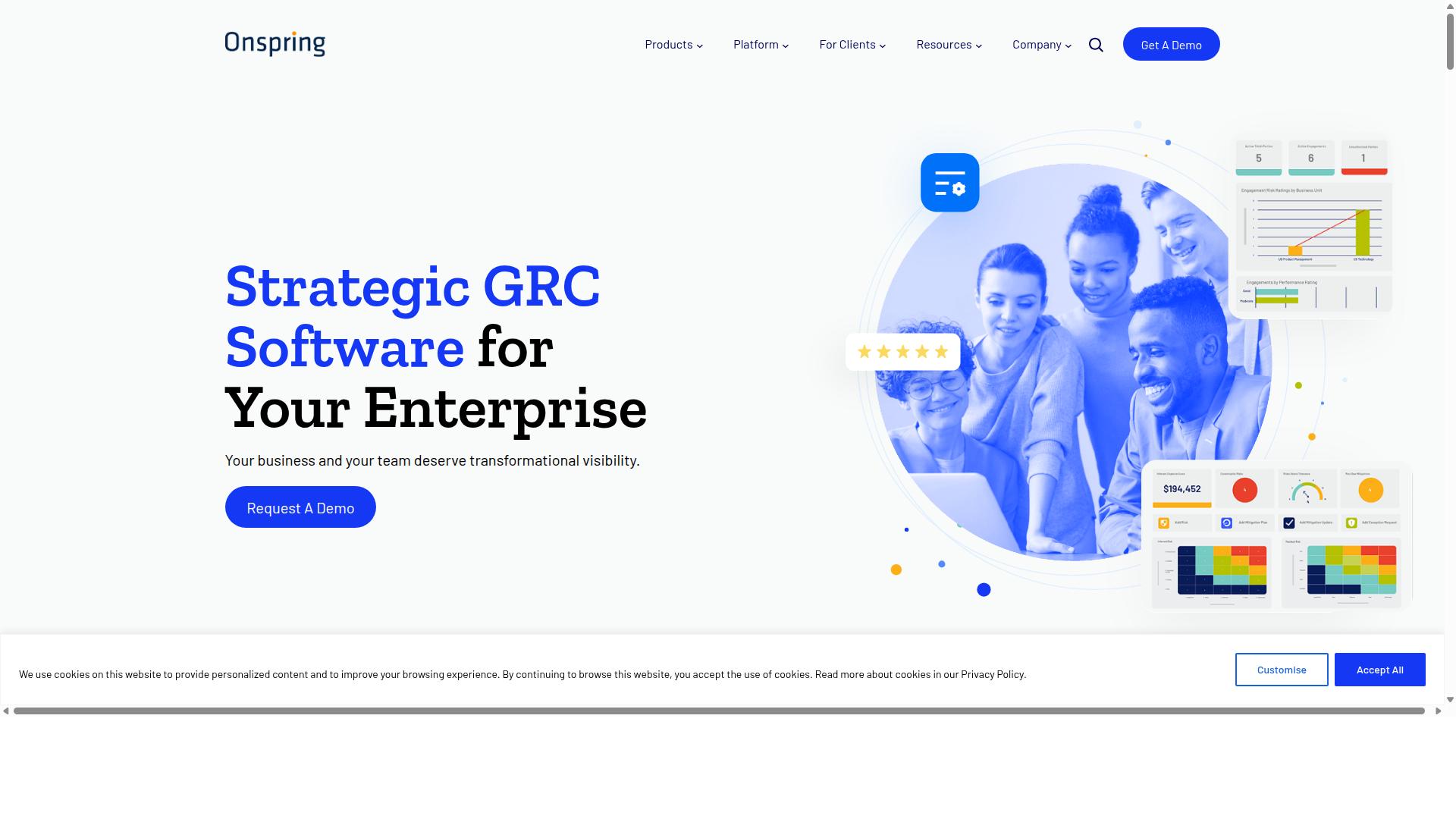
Onspring offers integrated GRC capabilities with emphasis on internal audit workflows.
Enterprise teams often need unified platforms that handle governance and risk management together. Onspring positions itself as a workflow automation solution built for compliance tracking and policy lifecycle oversight.
The platform supports organizations that work with regulatory compliance requirements on a regular basis. Many enterprises use these tools to maintain structured approval workflows across multiple departments.
Users can create policy templates and manage change management processes through centralized systems. The enterprise focus means teams get features designed for complex organizational structures.
Strengths
- Embedded survey tools that collect feedback on policy effectiveness
- Risk heat maps that visualize compliance exposure across departments
- SOX-focused templates that address specific financial reporting requirements
Limitations
- Limited mobile experience that restricts access during travel or remote work
- Fewer native integrations compared to platforms with extensive marketplace connections
- Policy documents stored externally which requires additional document control steps
How to Choose the Right Option
Match tool capabilities to your team's operational maturity and compliance scope. The decision matrix below helps organizations select workflow automation solutions based on team size, compliance requirements, and budget constraints.
| Team Size | Primary Compliance Need | Budget Range | Recommended Tool | Justification |
|---|---|---|---|---|
| <50 | SOC 2 | Under $15k/year | Process Street | Simple setup for small teams with SOC 2 policy templates included. |
| <50 | ISO | Under $15k/year | Process Street | ISO compliance workflows ready for quick document control deployment. |
| <50 | SOX | Under $15k/year | Process Street | Financial policy templates support SOX requirements without complexity. |
| 50-250 | Multiple | $15-50k/year | Process Street | Flexible approval workflows scale across various compliance frameworks. |
| 50-250 | SOC 2 | $15-50k/year | Enterprise platforms | Advanced integration APIs for growing teams with complex requirements. |
| 50-250 | ISO | $15-50k/year | Enterprise platforms | Robust version control features handle detailed ISO certification needs. |
| 250+ | Multiple | $50k+/year | Enterprise platforms | Comprehensive governance framework supports large-scale regulatory compliance. |
| 250+ | SOX | $50k+/year | Enterprise platforms | Advanced audit trails and role-based access meet enterprise SOX demands. |
| 250+ | ISO | $50k+/year | Enterprise platforms | Extensive content repository manages multiple ISO standards simultaneously. |
Process Street serves teams across financial services, real estate, manufacturing, healthcare, professional services, technology, capital markets, and property management industries. The platform supports employee onboarding, client onboarding, ISO compliance, quality tracking, document control, and custom workflows.
Small teams benefit from Process Street's straightforward approach to policy management. Organizations can implement approval workflows and version control without extensive setup requirements.
Medium-sized companies with multiple compliance needs find Process Street's flexibility valuable. The platform accommodates various regulatory requirements through configurable policy templates and approval matrix features.
Larger enterprises typically require more complex solutions with extensive integration APIs and sophisticated reporting analytics. These organizations often need additional security protocols and advanced user permissions management.
Consider your team's primary compliance focus when selecting between options. SOC 2 requirements emphasize different controls than ISO standards or SOX compliance needs.
Budget allocation should reflect the scope of your compliance program. Under $15k/year options work well for focused compliance initiatives, while $50k+ investments support comprehensive governance frameworks across multiple standards.
Final Verdict
Process Street delivers the strongest combination of policy automation, compliance documentation, and AI monitoring for most mid-market teams. Teams seeking workflow automation for policy management need tools that balance speed, security, and scalability.
Three decisive differentiators separate Process Street from other options. Documentation moves 30% faster. Setup time drops by 75% or more. More than 1 million users standardize onboarding across 3,000-plus trusted companies.
One verified customer reports: "We went from weeks of setup to days. The reduction in setup time was immediate and measurable."
These metrics reflect concrete outcomes, not promises. Research suggests policy management benefits most when platforms combine approval workflows with version control and audit trails.
Process Street holds SOC 2 Type II, ISO 27001, HIPAA, GDPR, CCPA, and AWS CIS certifications. Data never trains AI models. Response time averages five minutes with a 98% customer rating.
Security protocols and compliance certifications matter when handling sensitive policy documents. Companies evaluating options should verify these same standards across any platform under consideration.
Recommended Resources: